
Microsoft Dynamics NAV, long known as Navision, has held a central place in the management of small and medium-sized enterprises for nearly two decades. Originally developed in Denmark in the 1980s, this ERP has gone through multiple versions before reaching a reference status in the SME/SMB segment.
Since 2018, Microsoft has stopped developing new features for NAV and no longer sells new licenses. The product is officially considered a legacy ERP, replaced by Dynamics 365 Business Central. Despite this shift, many organizations continue to use NAV on a daily basis.
End of the commercial cycle for Dynamics NAV and consequences for businesses
The first point to make clear: Microsoft no longer sells new NAV licenses. NAV 2018 and earlier versions are already phasing out or have phased out of official support. In practical terms, this means that security patches and regulatory updates (taxation, local accounting standards) are no longer guaranteed in the long term.
For companies still using NAV, the question is not whether they will migrate, but when. Staying on an unsupported version exposes them to compliance risks, particularly regarding electronic invoicing obligations that are tightening in Europe.
Field reports vary: some organizations with heavy customizations are delaying migration for fear of losing specific developments, while others are accelerating their transition to Business Central to benefit from the cloud and ongoing support.
Understanding what Microsoft Dynamics NAV ERP software offers remains relevant for companies in transition, if only to identify which modules to keep or replace during a migration.
Financial and logistics management modules in NAV
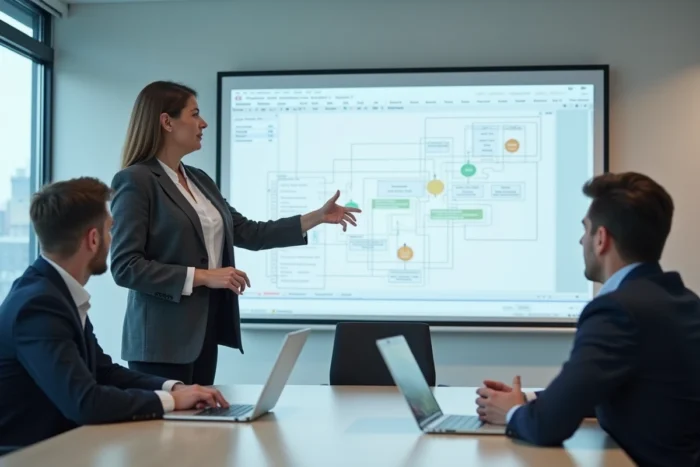
The functional foundation of Dynamics NAV is based on a particularly structured financial management core. The module covers general accounting, asset management, cash flow tracking, and bank reconciliations. For an SME, this scope was sufficient to centralize all financial flows without resorting to third-party tools.
Supply chain management constitutes the second pillar. NAV integrates purchasing, sales, inventory management, and, for more complex structures, warehouse management with location and picking functions. The manufacturing module allows for the management of bills of materials, production orders, and supply planning.
- Financial management handles accounting, assets, and cash flow in a unified environment, without double entry between modules.
- The logistics module manages the complete purchase-stock-sale cycle, including traceability of batches and serial numbers for regulated sectors.
- Manufacturing covers multi-level bills of materials, routing, and net requirements planning (NRP) to synchronize production and supply.
- Project management allows for budget tracking by project, with allocation of human and material resources to each cost line.
NAV centralizes finance, logistics, and production in a single repository. This integrated architecture avoids re-entries and discrepancies between departments, a concrete advantage for SMEs that previously managed these flows in separate spreadsheets.
Customization of NAV and technical limits in the face of cloud ERPs
One aspect rarely detailed in commercial presentations: the customization model of NAV is based on a proprietary development environment called C/AL (now AL in Business Central). This language allowed integrator partners to deeply modify the standard behavior of the software, even creating complete business modules.
This flexibility has a downside. Heavy customizations in C/AL greatly complicate migration to Business Central, as the code must be rewritten or adapted in AL with extensions. Companies that have accumulated specific developments over several years face migration costs proportional to their technical debt.

In contrast, cloud ERPs like Business Central bring capabilities absent from NAV. The Copilot AI layer, integrated into recent versions of Business Central, offers suggestions for accounting reconciliation, cash flow analysis, and stock forecasting. Copilot and AI are absent from NAV, which remains fixed on its last published features.
Deployment constitutes another structural difference. NAV primarily operates on-premise (on-site) or in a client-managed IaaS/PaaS cloud infrastructure. Business Central, available in SaaS, relieves the company from server maintenance, updates, and backup management. For SMEs without an internal IT team, this change radically alters the total cost of ownership.
Multi-currency, multilingual, and international management in Dynamics NAV
NAV was designed from the outset for companies operating in multiple countries. The ERP natively manages multi-currency and multilingual, which has contributed to its adoption in very different markets, from Denmark to North Africa.
Multi-currency management goes beyond simple amount conversion. NAV integrates exchange rate variances, periodic revaluations, and automatic adjustments on customer and supplier entries. For exporting companies, this functional layer avoided the need for complementary tools.
- Automatic management of exchange rate variances on foreign currency transactions, with adjustments at the end of the period.
- User interface available in multiple languages, configurable by user within the same database.
- Localized chart of accounts by country, incorporating tax obligations and specific reporting formats.
The available data does not allow for a conclusion on the exact number of maintained localizations today, some of which have been abandoned with the end of active development. International companies still on NAV must verify that their localization remains compliant with current regulatory obligations.
Dynamics NAV remains an ERP whose functional architecture has proven itself in the SME segment. The end of active support by Microsoft makes the question of migration to Business Central inevitable for any company wishing to continue benefiting from updates, regulatory compliance, and the contributions of artificial intelligence. Precisely assessing the functional scope used in NAV, the volume of customizations, and current business needs remains a prerequisite for any transition decision.