Remote access to the Zimbra messaging system of the CHU de Reims relies on a technical point that most guides overlook: the distinction between the internal URL and the URL exposed on the Internet. Typing the address used on CHU workstations from a home network systematically results in an authentication failure or a timeout, because the reverse proxy does not route requests in the same way depending on the network origin.
DNS Resolution and Zimbra Reverse Proxy: Understanding the Technical Block
The CHU de Reims operates two distinct DNS zones. Internally, workstations resolve a hostname that points to the Zimbra server on the local network (often an address like int.chu-reims.fr). From the outside, this resolution fails: the internal domain is simply not published in the public DNS.
The URL to use from the outside is mail.chu-reims.fr, which goes through the reverse proxy exposed on the Internet. This proxy terminates the TLS connection, verifies the credentials, and then relays the session to the Zimbra backend. Any attempt to access the internal address from a home network or a 4G/5G connection will remain unanswered.
A detail often overlooked: some agents save a bookmark to the internal interface from their hospital workstation. This bookmark becomes unusable at home. We recommend checking the address bar before any connection attempt and creating a dedicated bookmark explicitly pointing to mail.chu-reims.fr. To better understand the complete procedure to connect to Zimbra of the CHU de Reims from the outside, the distinction between these two URLs remains the technical prerequisite to master.
Multifactor Authentication and Constraints of the CaRE Program on Zimbra
The national CaRE program, deployed in 2026, primarily targets the reduction of Internet exposure of healthcare facilities and the control of technical directories. For CHUs, this translates into a concrete hardening of remote access to webmail.
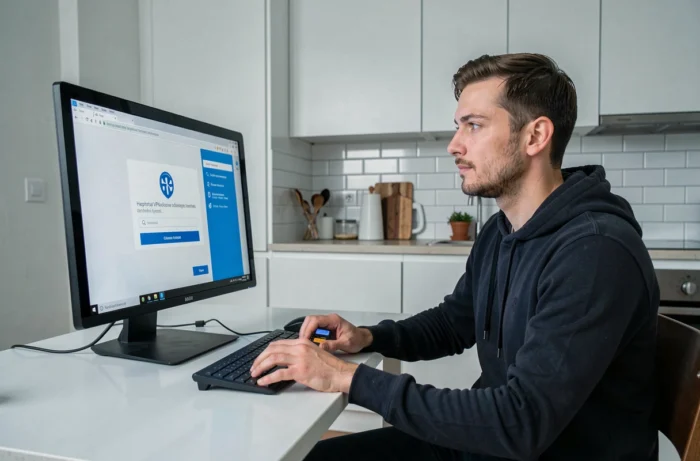
The trend observed since 2024 is the generalization of multifactor authentication (MFA) on exposed webmail access. Specifically, after entering the username and password on mail.chu-reims.fr, a second factor may be required: notification on an authentication app, SMS code, or hardware token according to the policy defined by the IT department.
The HAS certification now incorporates enhanced digital and cybersecurity criteria that explicitly aim to secure remote access. Facilities document the modalities of remote access and gradually limit direct access to webmail without MFA.
What This Changes for the Agent Connecting from Home
If your facility has activated MFA, you must have previously enrolled your second factor from the internal network of the CHU. Without this enrollment, remote connection will be denied even with valid credentials.
- Check with the IT department if MFA is active on your account before attempting a first remote connection
- Install the authentication app recommended by the facility (Microsoft Authenticator, FreeOTP, or equivalent validated by the IT department)
- Keep a backup method (registered phone number) in case of loss of access to the app
- Never attempt to enroll the second factor from an external network; the procedure requires an internal session
Choice of Zimbra Web Client: Modern or Classic for Remote Access
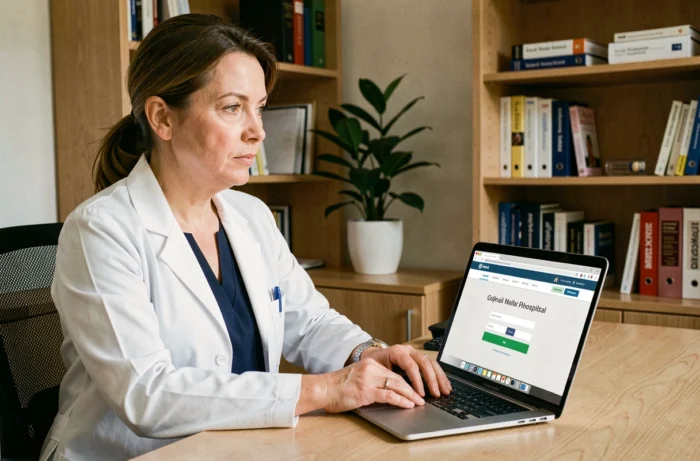
The login page mail.chu-reims.fr offers three options: Modern, Classic, and Default. This choice is not cosmetic; it has a direct impact on network compatibility and bandwidth consumption.
The Modern interface loads more JavaScript resources at startup. On a fiber home connection, the difference is negligible. On a mobile connection or a shared network with limited bandwidth, the initial loading time can take several seconds and cause session timeouts if the proxy cuts long connections.
The Classic interface remains lighter in initial resources and better supports unstable connections. For mobile use (smartphone, tablet), the Default setting generally redirects to the adapted version, but we observe that manually forcing the Classic mode on a mobile browser yields more stable results in low bandwidth situations.
Persistent Session Setting
The “Stay signed in” option on the login page maintains a session cookie. On a personal, non-shared device, this option reduces reconnection friction. On a shared workstation or public computer, it poses a direct security risk: anyone accessing the browser could view the messaging without authentication.
The session cookie has a limited lifespan defined server-side by the IT department. Even with “Stay signed in” enabled, a complete reconnection will be required at regular intervals.
Securing Personal Workstations for Access to Health Data
Accessing hospital messaging from a personal workstation exposes data covered by medical confidentiality. The regulatory framework requires facilities to document the conditions for remote access, but the responsibility for the client workstation partly rests with the agent.
- Keep the operating system and browser up to date: unpatched vulnerabilities are the main vector for session interception
- Avoid public Wi-Fi networks (hotels, train stations, cafes) to check your CHU messaging. Prefer a 4G/5G connection or a home network protected by WPA3
- Do not store attachments containing patient data on the local disk of an unencrypted personal device
In 2026, ANSSI and health cybersecurity stakeholders emphasize the systematization of multifactor authentication combined with an updated workstation as the minimal foundation for any remote access to a health information system. A password alone, even complex, is no longer sufficient against phishing campaigns specifically targeting the Zimbra platforms of healthcare facilities.
The most protective reflex remains to explicitly log out after each session rather than just closing the tab. Closing the browser does not always destroy the session cookie, depending on the browser configuration and installed extensions. Clicking “Sign Out” in the Zimbra interface forces server-side invalidation.