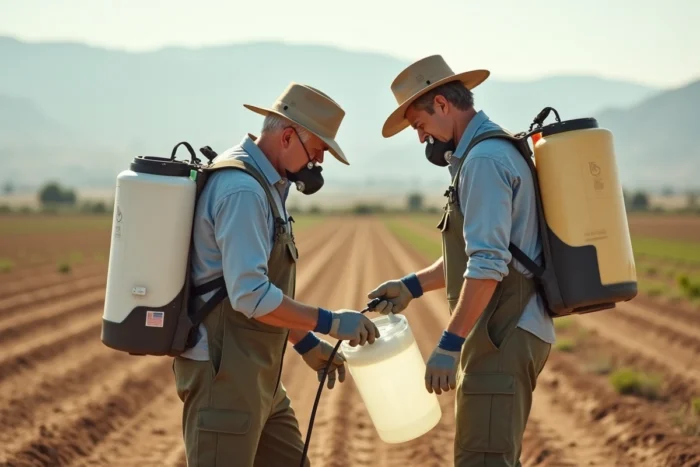
The glyphosate sold in 5-liter containers in Spain complies with labeling standards that detail doses per area, not just by tank volume. This distinction changes how the product is prepared and applied. Understanding these indications allows for adjustments to the treatment based on the actual conditions on the ground, whether for agricultural use or weeding on uncultivated surfaces.
Dose per area or dose per tank volume: what Spanish labels specify
The product labels for glyphosate 5 L available in Spain, such as Roundup Ultra Plus, provide doses expressed in mL per area. For uncultivated areas, recommendations go up to 600 to 1000 ml for 1000 m². In cultivated areas, the range drops to 300 to 600 ml for 1000 m².
This area-based approach differs from French-speaking guides, which almost always reason in milliliters for a given volume of water (for example, X ml for 5 liters of water). Thinking in terms of dose per m² requires measuring the plot before preparing the tank, which reduces the risk of overdosing.
Some Spanish labels intended for domestic outdoor gardening go further by indicating a dose of 1.25 cc/m² with a backpack sprayer. This level of precision allows for adapting the amount of product not to the volume of the mixture, but to the actual area treated. To use glyphosate 5 liters in Spain reliably, one must start with the area, then calculate the volume of water needed to cover it based on the flow rate of their sprayer.
| Type of area | Indicative dose (mL / 1000 m²) | Context |
|---|---|---|
| Uncultivated area (paths, fallow land) | 600 – 1000 | Established weeds, no vegetation to preserve |
| Cultivated area (between rows, pre-sowing) | 300 – 600 | Young weeds, presence of crops to protect |
| Domestic gardening (backpack sprayer) | 1.25 cc/m² | Small areas, targeted application |
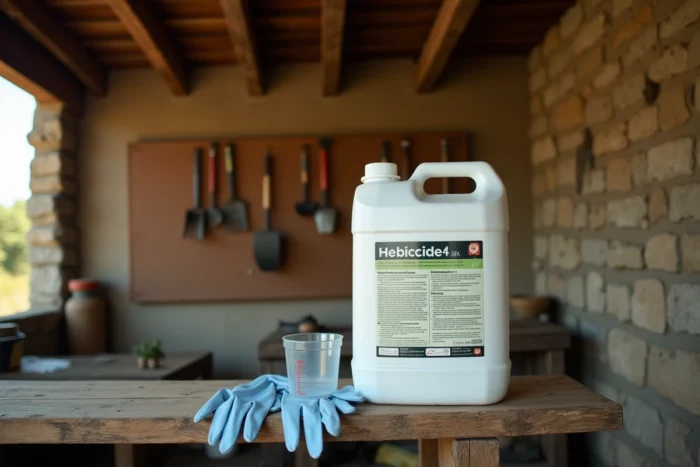
Application conditions for glyphosate: parameters that change the outcome
Glyphosate is a systemic foliar herbicide. Its effectiveness depends as much on the conditions at the time of treatment as on the dose applied.
Humidity and temperature
Humidity must exceed 70% for proper absorption by the leaves. Effectiveness increases further when it reaches 90%. The ideal temperature is between 15 and 25 °C. Below 10 °C, sap circulation slows down, and the product migrates poorly to the roots.
In Spain, the dry and hot periods of summer reduce humidity during the day. Treating early in the morning or late in the day improves foliar absorption, as the air retains more moisture during these times.
Weed stage
For annual weeds, treatment works best at a young stage, before the plant develops a thick cuticle. For perennials like thistle or bindweed, the logic reverses: one must wait for the plant to be sufficiently developed for the sap to descend to the rhizome and destroy the underground organs.
- Thistles: treat at the bud stage when the plant is about 15 to 20 cm tall
- Bindweeds: wait for stems over 20 cm, ideally at flowering
- Regrowth of crops (rapeseed, cereals): intervene before the 4-leaf stage for annuals
Timing the treatment to the plant’s stage is as important as the dosage itself.
Municipal ordinances: a local constraint to check before any treatment
The authorization of glyphosate at the European level, renewed in 2023, does not mean that its use is unrestricted everywhere in Spain. Agricultural use remains permitted nationally within the European regulatory framework. However, some Spanish municipalities impose restrictions on use in urban green spaces.
These restrictions take the form of municipal ordinances, local decrees that each municipality can adopt independently. An individual or a professional using glyphosate 5 liters to weed a non-agricultural area (sidewalk, path, around a building) must check with their municipality if a local ban applies.
This verification is rarely mentioned in online usage guides, which limit themselves to the European or national framework. Ignoring a municipal ordinance exposes one to local sanctions, even if the product is freely sold in agricultural cooperatives or specialized stores in the same municipality.
Water quality and adjuvants: two underestimated variables
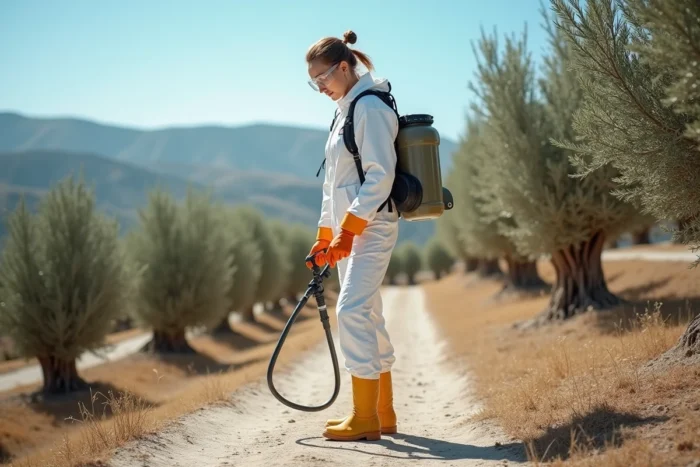
The hardness of the water used to prepare the mixture directly influences the effectiveness of glyphosate. Hard water (rich in calcium and magnesium) can reduce the activity of the active ingredient by forming insoluble salts. In Spanish regions where the network water is calcareous, this factor deserves attention.
Adding a suitable adjuvant (ammonium sulfate, wetting agent, or vegetable oil) can partially compensate for this issue. Wetting agents and spreaders improve foliar coverage and reduce runoff on waxy leaves. A low volume of mixture with a higher concentration often yields better results than a large diluted volume, as the amount of active ingredient per drop increases.
- Ammonium sulfate: corrects water hardness, improves foliar penetration
- Wetting agents/spreaders: reduce surface tension, limit runoff
- Vegetable oil: facilitates penetration through thick cuticles
The combination of corrected water, reduced mixture volume, and treatment at the right vegetative stage represents the technical triptych that separates an effective application from a partially failed treatment. The 5-liter container guarantees nothing without the accompanying method.