
Gesthand is the centralized software of the French Handball Federation (FFHB) that is gradually replacing several historical tools used by clubs to manage licenses, registrations, and administrative data. The transition from a fragmented ecosystem to a single platform profoundly changes the habits of volunteer leaders, sometimes without clearly stating the technical implications.
Access Security in Gesthand After the Cyberattacks of 2025-2026
The old FFHB tools often operated with shared credentials among several board members, typically an email address in the format “[email protected]” associated with a common password. This practice, tolerated for years, posed a traceability issue: it was impossible to know who had modified a license record or validated a registration.
Gesthand was targeted by security incidents at the end of 2025, and again in August 2026, serious enough to lead to a temporary suspension of the platform. The FFHB notified the CNIL and reported to the ANSSI. The Board meeting on September 4, 2026, approved a specific action plan, including mandatory two-factor authentication for all users.
In practice, a club that understands the differences between Gesthand and the old FFHB tools anticipates this constraint: each leader, secretary, or technical manager must have their own personal account. Sharing credentials among volunteers, still common in many organizations, is no longer compatible with the level of security imposed by the federation.
Digital Match Sheet: What Changes on the Field
With the old tools, the match sheet remained largely paper-based or semi-digital, entered afterward into a system disconnected from the license database. Transcription errors (misspelled names, reversed license numbers) regularly generated disputes before the claims commissions.
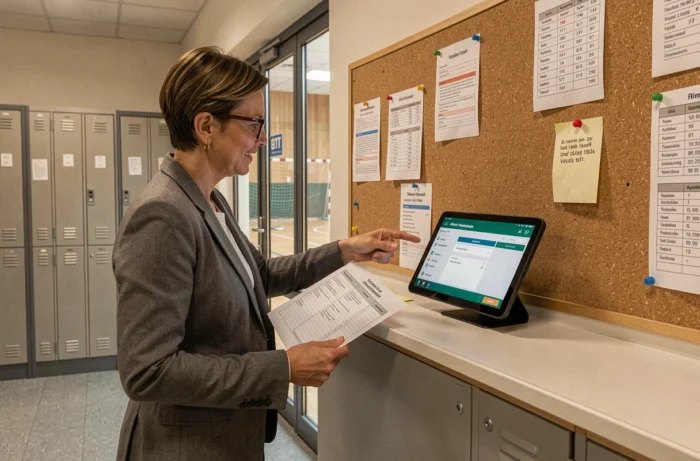
The FFHB has deployed via Gesthand a new fully digital federal match sheet, described by the federation as “simpler, more secure, and designed to evolve.” The direct link between the match sheet and the license database eliminates double entry. Players automatically appear from their validated licenses.
This integration has a direct consequence for the venue manager: license verification no longer involves a visual check on a printed document, but rather a real-time digital validation. A player whose license is not up to date in Gesthand simply cannot appear on the match sheet.
Points of Caution for Clubs on Match Day
- Check the internet connection of the venue at least one hour before kickoff, as the digital match sheet requires stable network access at the time of validation
- Ensure that the present manager has their own Gesthand credentials with two-factor authentication activated, and not those of another board member
- Verify the day before that all licenses of the summoned players are validated in the platform to avoid last-minute exclusions
Management of Licenses and Personal Data in Gesthand
In the old system, the data of licensed members was scattered across several databases: departmental committee file, local club extraction, treasurer’s spreadsheet. Gesthand centralizes all data in a single database accessible by levels of rights. The club sees its own licensed members, the departmental committee sees the clubs in its area, and the regional league accesses the higher level.
This layered architecture clarifies responsibilities regarding the protection of personal data. The club remains responsible for collecting consent (especially for minors), but the storage and technical security now fall under the federation via Gesthand.
Transfer of Access Between Leaders
A recurring problem with the old tools was the loss of access during the renewal of association boards. The outgoing president would leave with the password for the federation email, and the new board would spend weeks recovering access from the committee.
Gesthand mitigates this risk through personal accounts linked to a role. When a leader leaves their position, their access is disabled, and a new account is created for their successor. The administrative continuity of the club no longer depends on the goodwill of a single person.

Compatibility Between Gesthand and Third-Party Tools of Clubs
Many clubs use complementary software for accounting, communication, or training management (such as MyCoach by FFHandball for the sports aspect). The question of interoperability between Gesthand and these third-party tools is more pressing than with the old systems.
The old tools allowed for manual CSV exports, often cobbled together by the treasurer to feed a membership tracking spreadsheet. Gesthand offers export functions, but the format and granularity of accessible data vary according to the user’s level of rights.
A club that manages its memberships via an external association platform (like HelloAsso or Simpliasso) must ensure that the reconciliation between online payments collected and licenses validated in Gesthand can be done without manual re-entry. At this stage, no publicly documented open API allows for automatic synchronization between these tools and Gesthand.
The transition from the old FFHB ecosystem to Gesthand is not just a change of interface. Two-factor authentication, the digital match sheet, and data centralization change responsibilities within the club. Organizations that anticipate these adjustments, by training each leader on their own access and testing the digital chain before the first matches of the season, avoid administrative blockages that primarily penalize the players.