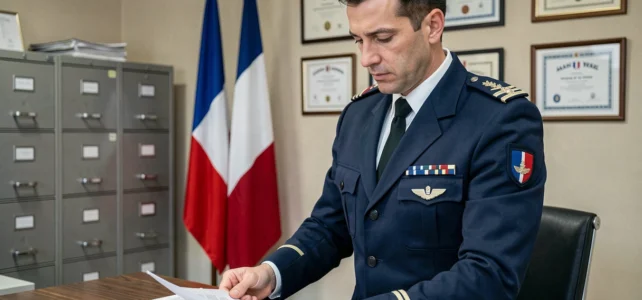
In the Air and Space Force, each aviator has a clothing entitlement that determines the uniforms and items they can claim throughout their career. This entitlement, governed by regulatory texts specific to the Ministry of the Armed Forces, is based on a system of initial allocation followed by periodic renewal. Its management has significantly evolved in recent years with the digitization of procedures.
Point account and arbitrations: the concrete functioning of the clothing entitlement
The clothing entitlement in the Air Force is based on a logic of points credit assigned to each aviator. This credit, allocated according to rank, specialty, and seniority, allows for the ordering of items via the digitized E-habillement platform. Each article (service uniform, operational uniform, sports gear, regulatory accessories) is associated with a cost in points.
This mechanism forces personnel to make choices. An aviator who spends all their points on operational uniforms may find themselves unable to renew their service or sports gear before the next cycle. To better understand the mechanics of consumed and remaining rights, the explanations available on E-habillement Air Force on Kali News detail these concepts precisely.
The initial allocation, given upon incorporation, covers a basic set of items. Subsequently, renewal depends on the observed wear rate and the scales set by the support management. Renewal cycles are not the same across specialties: an aeronautical mechanic wears out their uniforms faster than administrative personnel, which normally results in adjusted entitlements.
Stock tensions: when theoretical rights clash with logistical reality
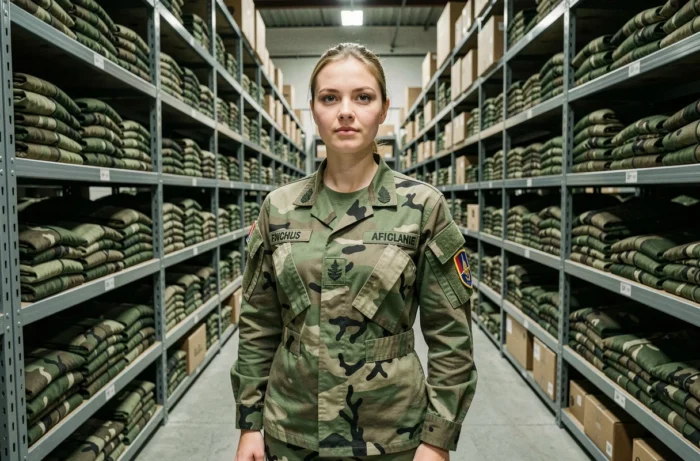
The regulatory framework guarantees a clothing entitlement, but the actual availability of items in stock regularly poses problems. Field reports converge on one observation: certain sizes and items remain unavailable for weeks, even months. This tension affects both standard uniforms and more specific items such as parkas, regulatory shoes, or ceremonial uniforms.
Testimonies from personnel shared on social media illustrate this difficulty. Non-commissioned officers report receiving the ironically phrased advice from their hierarchy to “change their morphology” to find available items in stock. Behind the jest, the problem is structural: the supply chain struggles to absorb the diversity of needs in terms of sizes, volumes, and specialties.
Several factors explain these tensions:
- The rationalization of purchases at the joint level, led by the Army Commissariat (SCA), has centralized supplies but lengthened some delivery times for low-rotation items.
- Public clothing contracts operate in batches and periods, creating temporary shortages between two supplier contracts.
- The rise of certain specialties (cyber defense, drones) generates needs for specific uniforms that are not always anticipated in the ordered volumes.
The concrete result for the aviator is a gap between the entitlement recorded in their E-habillement account and their actual ability to obtain the desired items. Having available points does not mean they can be spent immediately.
Clothing commission and regulatory uniform in the Air Force
The clothing and uniform commission for military personnel of the Air Force plays an advisory role on the evolution of uniforms, changes in cut or fabric, and the introduction of new items into the catalog.
Its work takes place over a long timeframe. Modifying a uniform or introducing a new item requires validating prototypes, launching contracts, and then building sufficient stocks before any distribution. This process generally takes several years from the initial decision to the effective availability on E-habillement.
The commission also arbitrates questions of dress identity. Since the name change to “Air and Space Force,” certain insignia and markings have had to be updated, leading to a gradual renewal of the affected items. These seemingly minor modifications require budget and logistical capacity.
The issue of ceremonial uniforms
Ceremonial uniforms crystallize some frustrations. They are costly in points, rarely worn on a daily basis, but are required by regulation during certain events. A young aviator who has not anticipated this expense in their credit may find themselves forced to borrow items from a comrade, a practice tolerated but which raises questions of regulatory compliance.
Clothing entitlement and military dress culture: what the texts do not say
Beyond the regulatory framework, the clothing entitlement is part of a dress culture unique to each army. In the Air Force, wearing the uniform follows unwritten codes that complement the official texts. The care given to the uniform, the choice of certain authorized accessories, the way to wear the cap or beret contribute to a collective identity.
The Penal Code also regulates the wearing of military uniforms outside of service. Any use that could create confusion with an active-duty military member is subject to criminal penalties. This legal framework also applies to former military personnel and civilians who purchase surplus items.
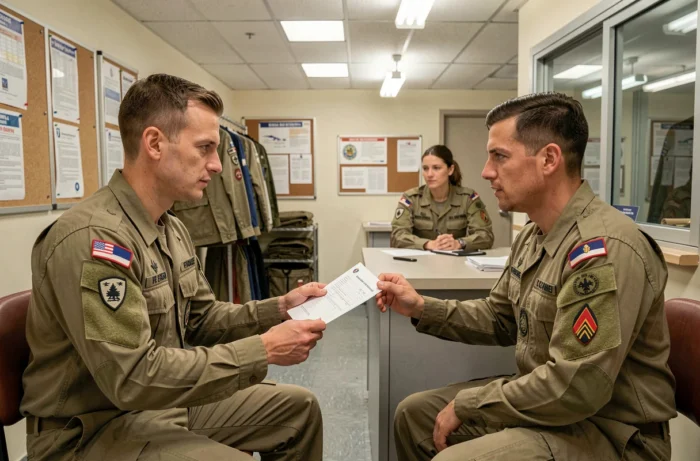
The durability of certain military fabrics and cuts explains their success in civilian style. The parkas, fatigues, and flight jackets of the Air Force have crossed decades and influenced fashion, from Parisian streetwear culture to haute couture collections. This circulation of military clothing into civilian life reminds us that military dress is not just a logistical matter: it is also a part of clothing history.
The clothing entitlement in the Air Force remains a technical subject where regulatory theory and daily practice do not always coincide. Digital tools like E-habillement have made the system more transparent, but they have also made its limitations more visible. For aviators, knowing how to manage their points account with foresight remains the best defense against the uncertainties of the supply chain.