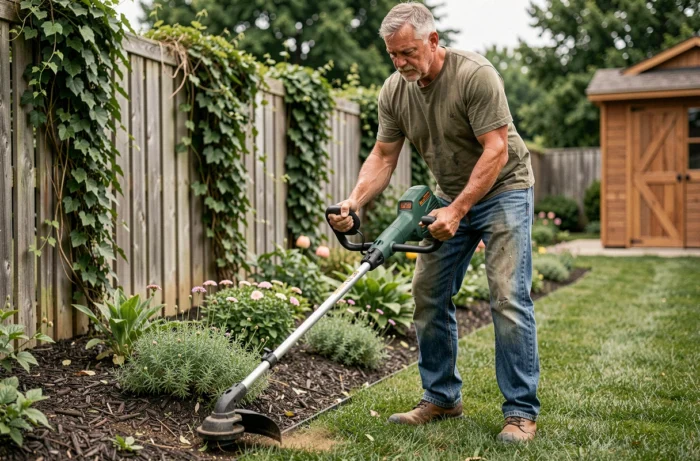
A string trimmer spins at several thousand revolutions per minute. At this speed, a simple nylon line cuts grass as cleanly as a blade. Understanding how it works allows you to better choose your cutting accessory, adapt your technique to the terrain, and avoid dangerous debris. This article details the mechanisms at play and then discusses the precise moment when the line is no longer sufficient.
Line, plastic blade, or metal blade: adapting the cutting accessory to the terrain
You may have noticed that your string trimmer struggles with certain clumps of grass while it easily trims closely mowed lawns? The problem rarely comes from the motor. It almost always comes from the accessory mounted on the cutting head.
To choose this accessory well, it is useful to understand how the string trimmer works and how each element interacts with the vegetation.
Nylon line, king of light finishes
The classic round line is suitable for short or medium-height grass, typically along edges and at the foot of fences. Its diameter determines its strength: the thicker it is, the more it can handle dense vegetation. A line that is too thin on tall grass breaks constantly and requires unwinding the spool every two minutes.
Choosing the line diameter based on the vegetation radically changes the comfort of work. For well-maintained lawns, a thin line is sufficient. For weeds that have gone to seed, a square or twisted line offers more bite.
Plastic blade: an underestimated middle ground
The plastic blade replaces the line on some models. It cuts more decisively, withstands semi-woody stems better, and generates less debris than a line that whips the ground. In return, it wears out quickly on rocks and does not tolerate contact with a wall or post.
Metal blade: the boundary with the brush cutter
When the vegetation becomes woody (brambles, shrub shoots, thick nettles), the nylon line is no longer sufficient. Metal blades with two or three teeth can cut through this type of growth without difficulty. Their use requires a harness, an expanded protective guard, and closed goggles. At this stage, the tool resembles a brush cutter more than a string trimmer.
- Short grass or maintained lawn: round nylon line, thin diameter.
- Tall grass or dense weeds: twisted or square-section nylon line, wider diameter.
- Semi-woody stems, thick nettles: plastic blade or two-pass technique (first reduce the height, then finish at the base).
- Brambles, woody shoots, wasteland: metal blade on a compatible device, or dedicated brush cutter.
Motor and cutting head: what really makes the string trimmer work
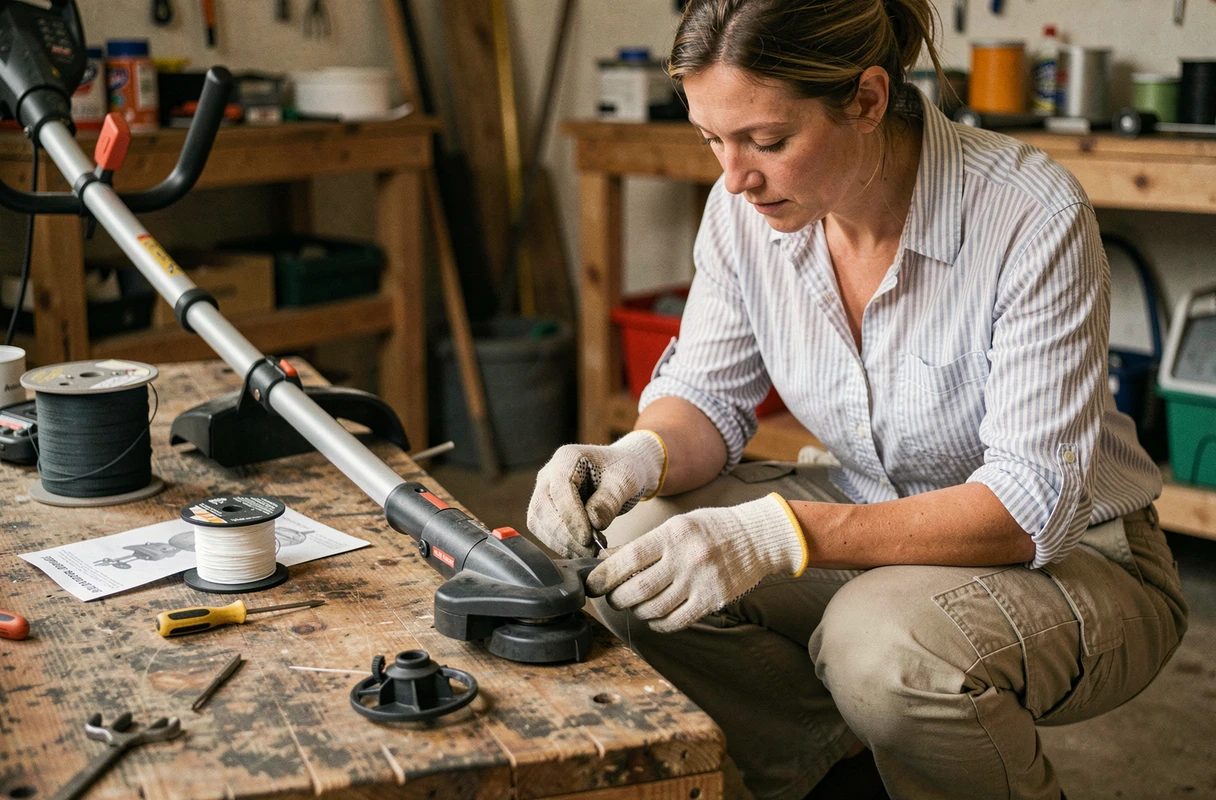
The principle is simple. A motor (corded electric, battery-powered, or gas) drives a shaft that spins the cutting head. Centrifugal force tightens the line or blade, and it is this high-speed tension that cuts through the vegetation. Without sufficient rotational speed, the line lies down instead of cutting.
Corded electric power
The corded motor provides constant power without autonomy limits. It is suitable for small gardens where a few meters of extension cord is sufficient. The cable remains its main constraint: it limits the working radius and requires constant monitoring of where it passes to avoid cutting it.
Lithium-ion battery
The battery frees movement around flower beds, on slopes, and in areas far from the house. The autonomy varies according to the battery capacity and the density of the vegetation. On tall grass, the motor works harder, and the battery drains faster.
Gas motor
The gas option remains the choice for large areas and rough terrain. Its superior power allows for heavier accessories (metal blades, reinforced line heads). It is heavier, vibrates more, and requires regular maintenance of the air filter and spark plug.
Debris and safety: the risk that many underestimate
A line spinning at full speed does not only cut grass. It can launch stones, wood chips, and plastic fragments. Debris is the primary danger of the string trimmer, well before the risk of direct cuts.
The protective guard deflects most debris to the ground, provided it is correctly positioned. Many users remove it for better visibility or access. This is a mistake that exposes legs, eyes, and nearby people.
Why does the metal blade exacerbate the problem? Because it strikes obstacles harder. A stone hit by a nylon line travels a few meters. The same stone struck by a metal blade can be projected much farther and with significantly more energy.
- Wear closed protective goggles (not just sunglasses).
- Wear long pants and sturdy shoes, even in warm weather.
- Check the ground before starting: remove stones, toys, metal wires.
- Never work when someone is within several meters.
Two-pass cutting technique on tall grass
On vegetation that exceeds knee height, cutting in two passes avoids clogging the head and extends the life of the line. The first pass reduces the height by half, working from right to left (for a string trimmer turning counterclockwise). The second pass trims the base in the opposite direction.
This method also reduces the load on the motor. On a battery model, it can make the difference between finishing the job or running out of power halfway through. On a gas model, it prevents overheating and repeated line breakage.
If despite two passes the tool still struggles, it is a sign that the vegetation exceeds its capabilities. At this point, it is better to bring out a brush cutter equipped with a grass blade or a bramble disc, rather than forcing a string trimmer that is not designed for this work.
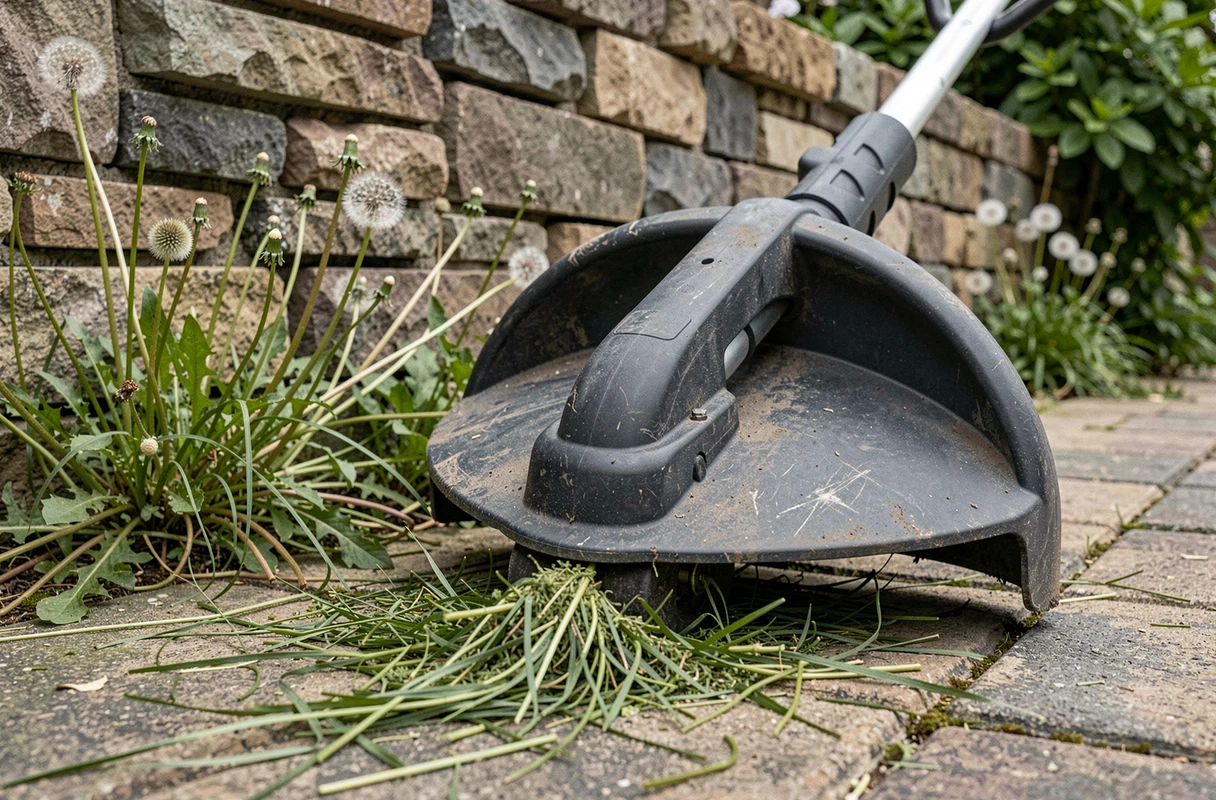
The string trimmer remains the most versatile finishing tool for a regularly maintained garden. Its effectiveness primarily depends on the mounted accessory and the technique employed. Nylon line for neat edges, plastic blade for tough grasses, metal blade or brush cutter for wasteland: each situation calls for a precise choice, not a universal tool.