
Contemporary painting refers to the pictorial productions created by living or active artists since the second half of the 20th century. It is distinguished from modern painting by the breaking of codes: frequent abandonment of the rectangular frame, mixing of mediums, dialogue with photography or sculpture. Buying an original work means acquiring a unique piece produced directly by an artist, as opposed to a reproduction or a limited edition.
Pop-up galleries and vacant spaces: a new circuit for contemporary painting
Traditional galleries are no longer the only access point to original works. In recent years, collectives of artists and associations have been occupying empty commercial spaces to host temporary exhibitions of contemporary painting. This phenomenon, documented by the regional press, is changing the geography of artistic dissemination in France.
The mechanism is simple: a municipality or a property owner makes a vacant space available, and painters hang their works there for a few weeks. Visitors can enter without an appointment, without the sometimes intimidating filter of an established gallery. The original work becomes accessible in a daily setting, between a bakery and a tobacco shop.
This hybrid format benefits both artists and municipalities. Contemporary painters gain local visibility without bearing the costs of a traditional commercial lease. City centers regain lively storefronts. Initiatives of this kind have brought together several dozen artists in the same summer in certain French cities, proving that the model appeals beyond experimentation.
To explore original works online and discover the work of contemporary painters, you can visit the site ricci-art.net to browse various artistic approaches without having to travel.
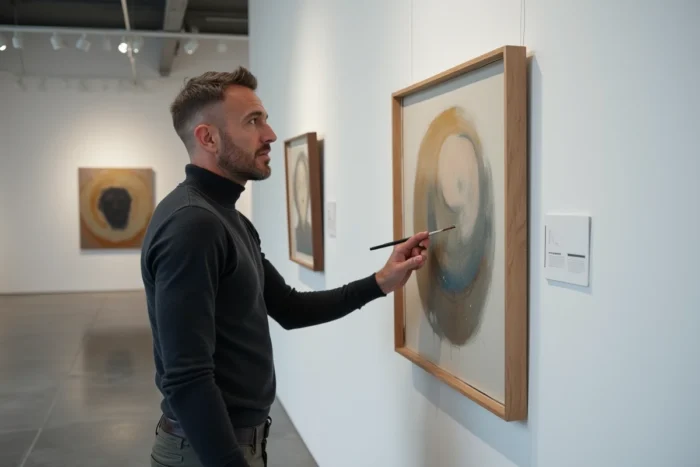
Contemporary figurative, abstract, or street art: guidelines for orientation
The term “contemporary painting” encompasses very different movements. Without some guidelines, a buyer or enthusiast can quickly get lost among the labels. Three main families structure current production.
Contemporary figurative painting
It represents identifiable subjects (bodies, landscapes, objects) but moves away from photographic realism. Contemporary figurative artists work with distortion, saturated color, or cinematic framing. Florian Krewer, recently exhibited at the Musée d’art moderne de Paris, illustrates this approach with large-format canvases where bodies appear in motion, almost blurred.
Abstract painting
Abstraction remains the dominant movement in contemporary art galleries. The painting does not refer to any external subject: the composition relies on color, material, and gesture. Some French abstract painters work in successive layers, scraping the surface, integrating natural pigments. The work is then read as a material object as much as a visual one.
Street art and pop art in galleries
Street art and pop art, long confined to the street or screen printing, are now entering sales spaces in the form of original paintings. Specialized galleries offer unique canvases from artists coming from graffiti or urban illustration. The transition from wall to canvas transforms the status of the work: it becomes a collectible and interior decoration object, with a very wide price market.
Buying an original artist’s painting: concrete selection criteria
Acquiring an original contemporary painting is not just a matter of a crush. Several technical and practical criteria should be checked before purchase, whether in a gallery or online.
- The certificate of authenticity guarantees that the work is indeed by the artist. It mentions the title, dimensions, technique, and signature. Without this document, resale and insurance become complicated.
- The technique used (oil, acrylic, mixed media) influences the durability and maintenance of the painting. An oil painting on linen canvas ages differently than an acrylic on mounted paper.
- The format and support determine the hanging. A standard wooden frame is easy to fix, while an aluminum panel or a free canvas requires custom framing.
- The artist’s rating, available on auction platforms, gives an indication of the pricing position. A contemporary painter exhibited in public institutions (FRAC, art centers) generally benefits from visibility that supports the value of their works.
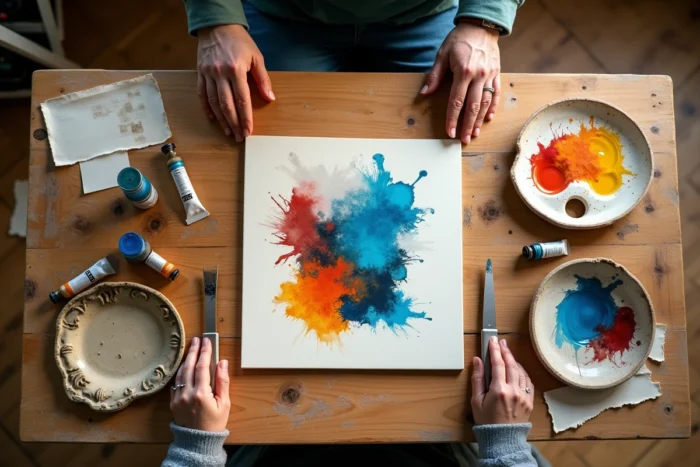
Female contemporary painters: increasing visibility
The scene of contemporary painting in France is increasingly giving space to female artists. Regional events now structure their exhibitions around thematic axes related to gender. The “Current Art” exhibition in Poussignac, scheduled for 2026, has chosen the theme “Feminine” and presented four female artists, including a painter and a contemporary embroiderer, all producers of original works.
This trend goes beyond the event framework. Art blogs and magazines dedicate entire features to contemporary French female painters, a sign that editorial demand accompanies institutional recognition. The increased visibility of these creators is also changing the market: their paintings, sometimes undervalued a decade ago, are reaching price levels comparable to those of their male counterparts in the same galleries.
This rebalancing concerns not only figuration or abstraction. Female artists are also investing in contemporary embroidery or mixed techniques, blurring the boundaries between decorative arts and fine arts. The original work of a contemporary female artist has become a distinct segment of collection.
Contemporary painting is now discovered as much in a vacant space transformed into a pop-up gallery as in a national institution or on an online platform. The certificate of authenticity remains the first reflex to adopt before any purchase, and the diversity of movements, from figurative to street art, allows every budget and sensitivity to find an original painting that lasts over time.