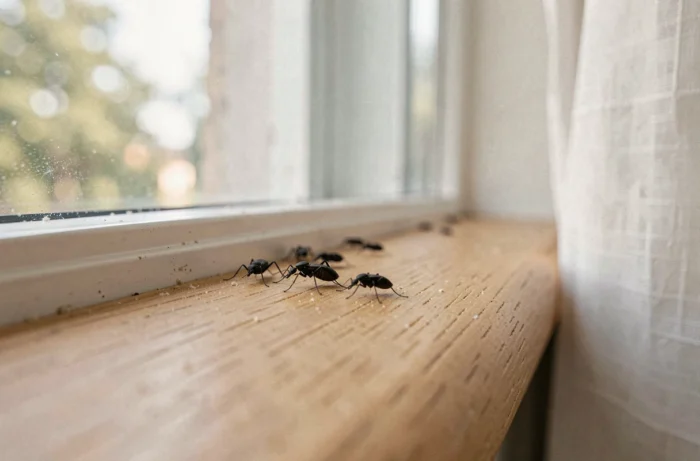
Most of the small black insects that colonize window sills are not established pests: they are transient organisms attracted by a local microclimate. Before spraying anything, we recommend addressing the problem at its source, namely the conditions that make your joinery attractive.
Window seals, VMC, and micro-leaks: the structural diagnosis that replaces insecticide
A black insect on a window sill almost always indicates a defect in the structure, not a food infestation. Three checks are enough to resolve the majority of cases without resorting to chemical treatment.
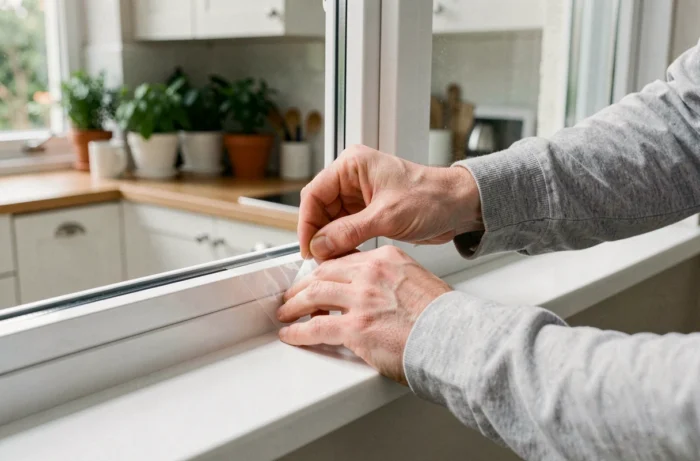
- Condition of window seals: a cracked PVC or silicone seal creates a draft of humid air between the inside and outside. Psocids, small beetles, and fungus gnats exploit this buffer zone as a temporary habitat.
- Proper functioning of ventilation: a clogged VMC or blocked air vents increase the relative humidity around the joinery. Local humidity is the primary factor attracting these species.
- Absence of micro-water leaks: an invisible infiltration along a window sill or in a roller shutter track generates a permanent condensation zone. As long as this leak persists, insects will return after each cleaning.
This structural approach is rarely highlighted in mainstream content, which directs people straight to white vinegar or insecticide. Repairing a seal costs a few euros and addresses the problem upstream, while a spray only treats the symptom.
To understand why small black insects at the edges of windows appear seasonally, one must also consider the variations in outdoor temperature that affect condensation on the joinery.
Transient or resident species: adapting treatment to the correct entomological diagnosis
Treating without identifying amounts to applying a protocol blindly. The most common species on window sills do not respond to the same levers.
Psocids and springtails: markers of humidity
These micro-arthropods (often less than 2 mm) do not bite, nor do they consume textiles or stored food. Their presence indicates excess humidity and sometimes microscopic mold on the frame or adjacent wall. Removing the humidity eliminates them without any product.
We regularly observe that these species disappear within a few days after simply restoring ventilation or replacing a defective seal.
Dermestids: a textile problem, not a window problem
Adult dermestids measure 2 to 4 mm, have dark scales, and are found on windows because they seek light to exit. Their presence on the sill is a warning signal: dermestid larvae feed on keratin in textiles (wool, silk, feathers, fur). Treatment does not occur at the window but in closets, carpets, and corners of the house where fibers and dust accumulate.
A thorough cleaning of stored textiles, followed by steaming or freezing infested items, remains the most reliable protocol.
Dermestes: seeking the organic source
Larger than dermestids (up to 8-10 mm for some species), dermestes indicate the presence of decomposing animal matter: an abandoned bird’s nest in a roller shutter box, a rodent carcass in a false ceiling, or an accumulation of hair in a duct. As long as the organic source is not removed, surface treatment is useless.
Targeted cleaning protocol for window sills and frames
Once the diagnosis is made and the structural cause corrected, a methodical cleaning prevents the return of insects.
Start by thoroughly vacuuming the tracks, drainage grooves, and the inside of the roller shutter box. These areas accumulate organic debris, dust, and stagnant water, creating an ideal micro-habitat. The vacuum cleaner is more effective than a damp cloth for removing eggs and larvae lodged in crevices.
Then clean with a mixture of hot water and black soap. White vinegar, often recommended, has no real insecticidal effect: it deodorizes and degreases but does not kill larvae or eggs. Its usefulness is limited to temporarily discouraging return with its acidic smell.
After complete drying, apply a thin line of diatomaceous earth in the window grooves. This non-toxic mineral product for mammals acts by abrading the waxy cuticle of insects, causing their dehydration. Diatomaceous earth remains active as long as it stays dry, which requires renewing it after each episode of condensation or rain.
Artificial light and windows: reducing nocturnal attraction
Many species of small black insects exhibit positive phototropism. In the evening, indoor lighting visible from outside turns every window into an attractive trap.
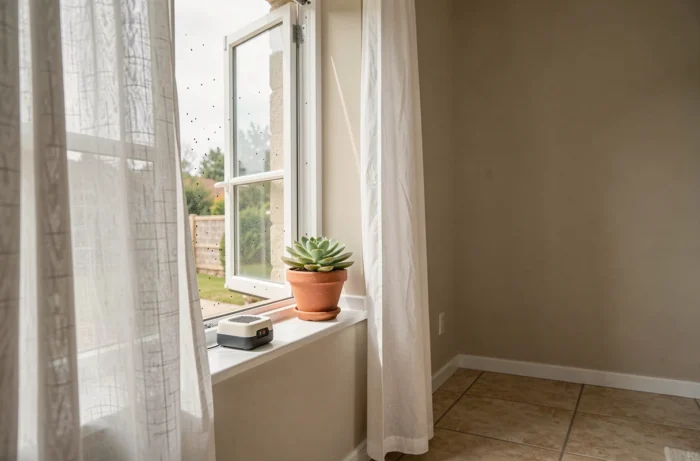
Replacing cold white spectrum bulbs (rich in blue wavelengths) with warm spectrum bulbs (2,700 K or less) significantly reduces the light attractiveness for most nocturnal diptera and beetles. Fine mesh screens (less than 1 mm) complement this measure by creating a permanent physical barrier.
Closing shutters or lowering blinds before turning on indoor lighting remains the simplest method to cut the light signal. This reflex, combined with airtight seals, eliminates almost all entries of transient insects through the windows.
Resorting to a contact insecticide is only justified in the face of a confirmed infestation of resident species (numerous dermestids, dermestes with identified sources) and after structural measures have failed. In all other cases, correcting humidity, sealing access points, and adapting lighting are sufficient to make your windows inhospitable to these unwanted visitors.