
A translucent worktop that hints at turquoise pigments, a table top crossed by a luminous vein imitating a river, an accent wall with pearlescent reflections: epoxy resin transforms ordinary surfaces into unique pieces. This bi-component material, a mix of a base and a hardener, adheres to most substrates and can be tinted at will. However, it is essential to understand what distinguishes a successful resin creation from mere varnished DIY.
Epoxy resin and indoor air quality: a constraint that no one details
Have you ever noticed a slight chemical smell when unpacking a new piece of furniture? This odor often comes from volatile compounds released by glues and coatings. Epoxy resin is not exempt from this issue.
The REACH regulation has introduced a restriction (entry 77) that sets a formaldehyde emission limit of 0.062 mg/m³ for wood-based furniture and 0.080 mg/m³ for other items intended for interiors. These thresholds will come into effect on August 6, 2026.
In practical terms, a river table made of wood and resin or a wall panel embedded with pigments must comply with these limits measured in a standardized chamber. Artisans pouring resin over oak or walnut must ensure that their formulation does not exceed these values once curing is complete.
This regulatory framework encourages the selection of low VOC emission resins, often identified by technical data sheets specifying residual rates. Before ordering a custom piece, asking the creator for this sheet remains the most reliable reflex. On zam-creation.fr, the proposed creations illustrate this approach where aesthetic rendering is accompanied by a concern for material quality.

Bio-sourced epoxy resin: a sustainable alternative for decor
Classic epoxy resin is based on petrochemical derivatives. In recent years, bio-sourced formulations have emerged on the market. They incorporate a portion of plant materials (linseed, soybean, or castor oils) into the polymer’s molecular chain.
The global market for bio-sourced epoxy resins is experiencing notable growth, driven by demand from the construction, automotive, and interior decoration sectors. For an individual wanting a custom table top or coasters, the interest is twofold: reduce the carbon footprint of the object without sacrificing transparency or hardness.
In practice, these bio-sourced resins are worked in the same way as their conventional counterparts. The polymerization time may vary slightly, but pigments, glitter, and inclusions (dried flowers, leaves, sand) integrate without difficulty. The additional cost remains moderate compared to standard resin.
Customized resin creations: effects that change a space
Resin alone is transparent. All customization comes from what is added and how it is poured. Three families of effects deserve attention because they produce radically different results.
Natural inclusions in resin
Encapsulating dried flowers, seashells, or fragments of driftwood in a clear pour freezes a moment of nature. The common pitfall: residual moisture. A poorly dried flower releases microbubbles that cloud the resin within hours. Experienced creators dehydrate the plants for several weeks before integrating them.
Pigments and depth effects
Metallic pigments (copper, gold, silver) create moving veins when lightly blown on the still liquid surface. Phosphorescent pigments, on the other hand, recharge in daylight and emit a glow in the dark. Why choose this over simple dyeing? Because the pigment moves within the thickness of the pour and generates a three-dimensional effect that a surface paint cannot replicate.
River table in wood and epoxy resin
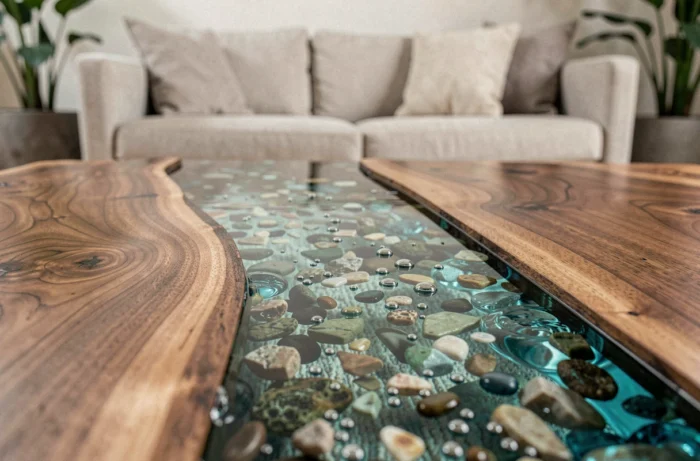
This is the most spectacular and technical creation. Two slabs of raw wood are separated by a pour of tinted resin that mimics the flow of a river. The difficulty lies in the watertight formwork and mastering the exothermic reaction: a pour that is too thick at once heats up to the point of yellowing or cracking. Artisans proceed with successive layers of a few centimeters.
Choosing a resin artisan: concrete criteria before ordering
Not all creators work the same way, and the final result depends as much on craftsmanship as on the chemical formulation used. Here are the points to check before placing an order:
- The technical data sheet of the resin used, mentioning VOC emissions and UV resistance (an unstabilized resin yellows within a few months near a window).
- The type of finish offered: a progressive sanding followed by a polyurethane varnish protects better than a simple raw demolding, especially for a table or worktop subjected to wear.
- Photos of completed pieces taken in natural light, not just under studio lighting that masks transparency defects.
- The complete polymerization time before delivery: a piece delivered too early may still emit odors and lack surface hardness.
An artisan who is transparent about these four points generally works with rigor. Requesting a sample of cured resin with the chosen pigment allows for validation of the actual shade before launching a costly piece.
Maintenance of epoxy resin objects: protecting the surface over time
Cured epoxy resin is resistant to light impacts and water. However, it is less tolerant of three common aggressions:
- Surface scratches caused by abrasive objects sliding without protection (stoneware plates, keys placed on a tray).
- Prolonged exposure to direct UV light, which dulls transparency and yellows light shades over several months.
- Household products containing acetone or concentrated alcohol, which dissolve the finish layer.
A damp microfiber cloth and a neutral cleaner are sufficient for regular maintenance. For fine scratches, a resin polish (sold in a kit with increasingly fine abrasive discs) restores shine without covering the entire surface.
Placing an anti-UV film on windows near a resin table or panel remains the most effective precaution to preserve colors over time. Customized resin creations gain longevity when their environment is considered from the outset.