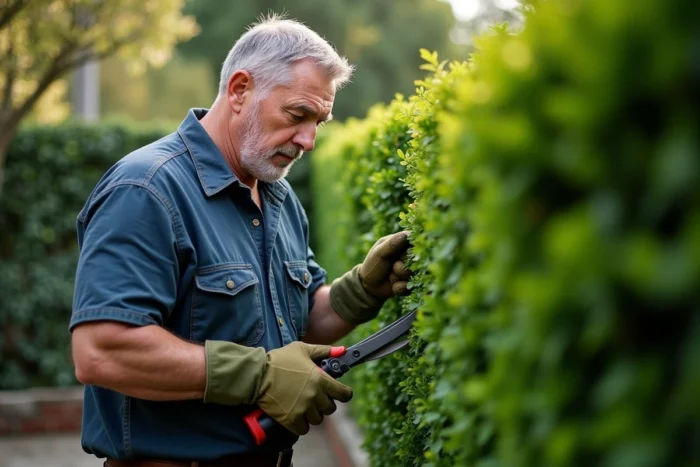
The artistic pruning of hedges relies on technical choices that most guides gloss over: selecting the natural growth habit of the species, managing secondary branching, and anticipating post-cutting water stress. Here, we address the fine points that separate a well-managed topiary from a battered shrub.
Branching and plant architecture: the foundation of a successful topiary
Every artistic pruning begins with reading the architecture of the tree or shrub. A boxwood (Buxus sempervirens) naturally branches in a sympodial manner, making it amenable to geometric shapes. A yew (Taxus baccata) tolerates severe cuts thanks to its dormant adventitious buds. In contrast, a cherry laurel poorly heals on large cuts and produces disorderly regrowth.
We recommend mentally mapping the branching levels before making the cut. Each cut should be made above a node oriented outward to encourage centrifugal growth and densify the silhouette. On fast-growing species like privet, this rule prevents inner thinning that can ruin a topiary in two seasons.
The choice of shape also depends on the natural growth habit. Flattening a sphere onto a columnar shrub requires disproportionate maintenance. Specialized resources like sculpte-haie.com help identify shapes suited to each species and avoid such errors in advance.
Topiary pruning of boxwood and evergreens: schedule and technical cuts
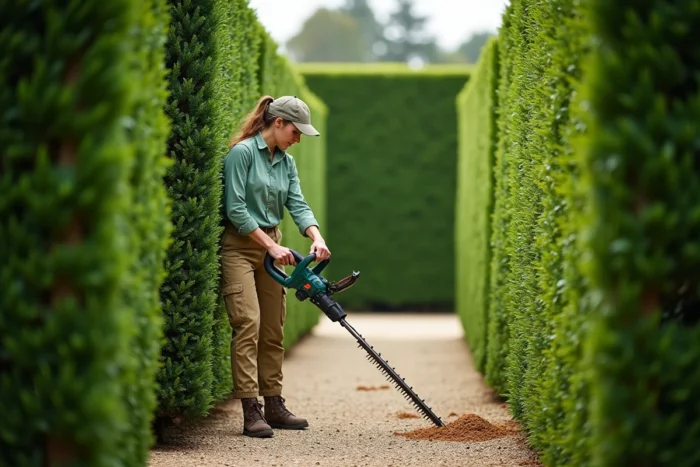
Boxwood is ideally pruned twice a year: a first pass after the spring growth (late May – June) and a second at the end of summer (September). Pruning boxwood after mid-October exposes young shoots to frost and weakens the plant against the box tree moth, whose larvae overwinter in the dense foliage.
For yews and Leyland cypress, the schedule differs. Yew can handle a hard cut in March, before bud break, followed by a light adjustment in August. Leyland cypress does not regenerate on old wood: we never cut beyond the green foliage, lest we leave permanent gaps in the hedge.
Technically, a trapezoidal cut (base wider than the top) remains the most reliable geometry for hedges over one meter in height. This slope ensures that light reaches the lower branches, maintaining density throughout the height of the plant.
Managing the cutting line and precision
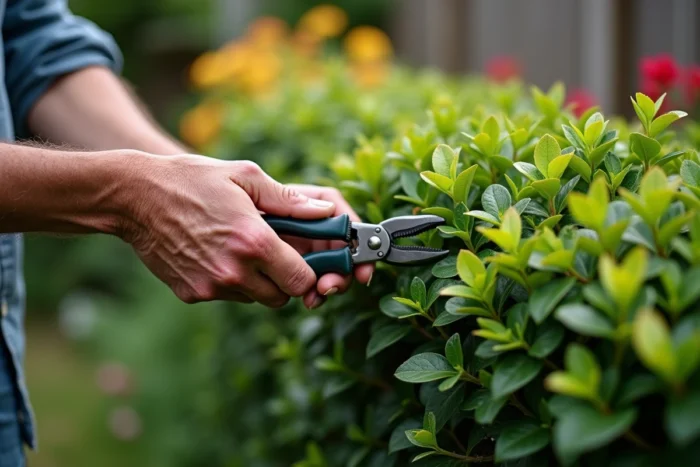
For a complex topiary (spiral, ball on a stem), we work with hand shears for the finishing touches. The electric or gas hedge trimmer is used for rough shaping, but the final precision is achieved with short-blade boxwood shears. A template made of wire or mesh placed directly on the plant guides the cut and avoids asymmetries.
Water stress and fertilization after hedge pruning
Pruning causes a loss of leaf surface that abruptly alters the transpiration/root absorption ratio. In clay soil during dry periods, this disturbance can trigger rapid drying of the remaining branches.
- Water generously at the base within 48 hours following a severe pruning, especially between June and August, to compensate for the reduction in canopy
- Apply organic mulch (wood chips, bark) to a sufficient thickness to limit evaporation and nourish the soil as it decomposes
- Postpone any nitrogen fertilization for at least three weeks after cutting, as nitrogen stimulates tender regrowth more susceptible to fungal diseases
A severely pruned shrub during a heatwave can lose more water than it absorbs, even with regular watering. If temperatures exceed usual summer peaks, we postpone maintenance pruning to September.
Biodiversity and nesting periods: real constraints for the gardener
Regulations regarding pruning during nesting periods clearly distinguish between private individuals and agricultural operators. In an agricultural context, hedge pruning is prohibited from March 16 to August 15. For private individuals, no national text imposes this prohibition, but municipal or prefectural orders may apply locally.
Beyond the legal framework, the ecological question deserves attention. Hedges constitute micro-habitats for beneficial insects and nesting birds. Pruning in April or May can destroy active nests of blue tits, blackbirds, or robins located within the dense foliage.
We recommend a quick visual inspection before any intervention between March and July. An occupied nest is easily spotted: birds making trips, droppings on the ground, alarm calls upon approach. If a nest is detected, the affected section is spared until the young have fledged.
Ecological continuity and plant corridors
Hedges play a role as biological corridors between fragmented green spaces. Pruning an entire long hedge at once temporarily removes this refuge function. Alternating pruned sections from one year to the next keeps a dense part available at all times where wildlife can retreat.
Ergonomics and tool choices for prolonged pruning
Recent field feedback shows that work comfort has become a selection criterion as crucial as cutting quality. For hedges over two meters, a pole hedge trimmer significantly reduces neck fatigue and eliminates the need for a ladder.
- The carrying harness distributes the weight of the tool across the shoulders and hips, allowing for sessions longer than an hour without lower back pain
- Battery-powered models offer a suitable weight/power ratio for garden hedges, without the excessive vibrations of gas-powered engines
- For fine topiary, interchangeable blade shears (straight for flat surfaces, curved for rounded shapes) remain irreplaceable
The trend towards low-maintenance hedges is gaining ground. Some species like eleagnus or photinia only require annual cutting, reducing the workload without sacrificing the garden’s structure. Choosing a species suited to the desired outcome remains, in advance, the most cost-effective decision in the long term.