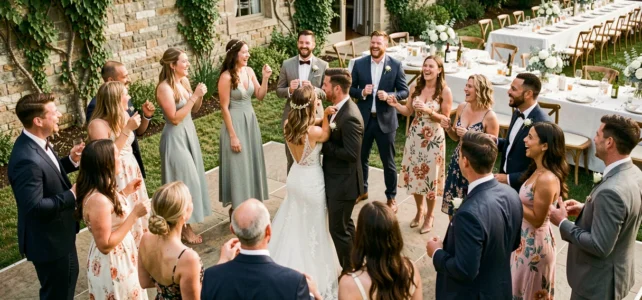
A couple planning four activities often ends up launching only two, due to time constraints between the cocktail reception and the entrée. The real issue is not to multiply wedding entertainment ideas, but to choose those that fit into the actual schedule of the day, without turning the celebration into a school program.
Timing and logistics of wedding activities: what gets stuck on the ground
Most lists of activities overlook one detail: there are only short time slots available. The cocktail reception rarely lasts more than an hour and a half. The time between courses is counted in minutes. Setting up an escape game, briefing the teams, playing, and then cleaning up before the next course is a logistical challenge.
Before choosing an activity, three concrete points should be checked with the venue: the available space (indoor, outdoor, or both), the noise level tolerated by the neighbors, and the presence or absence of electrical outlets near the designated area. A photobooth without an extension cord nearby is a photobooth that doesn’t work.
By browsing the activities on the Info Mariage site, one quickly notices that some activities require a dedicated provider and heavy equipment, while others fit in a box. Organizing activities by logistical constraints before sorting them by preference saves considerable time in planning.
Audio guestbook and immersive activities: what replaces the classic photobooth
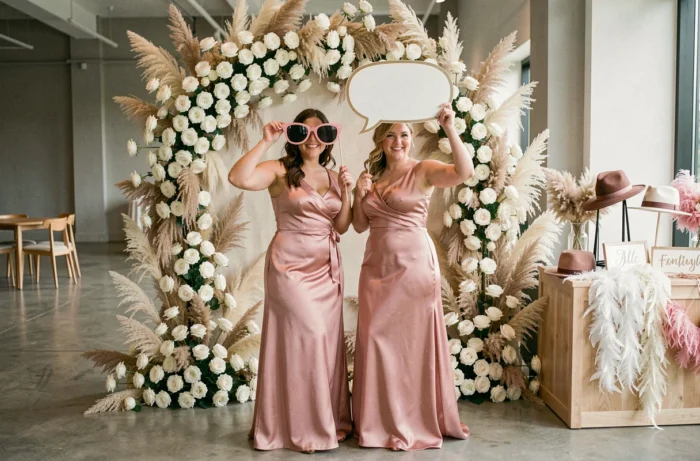
The photobooth remains a classic, but it is starting to show its limits. Cardboard props often end up on the floor after an hour, and printed photos get lost between tables. For about two years now, an alternative has been gaining ground: the audio guestbook.
The principle is simple. A vintage phone (or a retro handset connected to a recorder) is set up in a quiet corner. Guests pick up, leave a voice message for the couple, and then hang up. No waiting line, no mandatory costume, and the couple receives an audio file that they can listen to years later.
This format works well because it imposes nothing. Shy guests feel more comfortable alone in front of a handset than in front of a camera. Feedback varies on this point, but the trend observed by several specialized providers confirms that “guest experience” activities are taking precedence over mere decor. This category also includes participatory mixology (a bartender teaching a signature cocktail to guests) or sensory workshops around perfume or flowers.
GUSO obligation: the legal constraint that couples often overlook
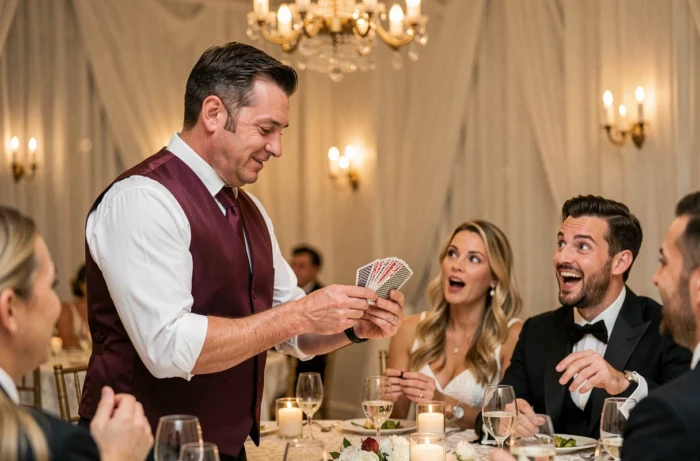
Hiring a close-up magician, a music group, or a salaried DJ for the evening is not just a matter of budget. In France, an individual hiring a live performance artist must go through GUSO (Guichet Unique du Spectacle Occasionnel). This obligation applies to anyone whose main activity is not organizing shows.
In practical terms, GUSO centralizes the hiring declaration, the employment contract, the payslip, and social contributions. Not using it exposes one to the risk of reclassification as undeclared work. Many couples are unaware of this and pay the provider “under the table,” which poses a problem in case of an accident at the venue.
When GUSO does not apply
If the provider is a self-employed entrepreneur or has their own performance license, they manage their social obligations. A standard invoice is then requested. The reflex to have: demand a SIRET number or license before signing anything.
Children’s wedding activities: a dedicated space rather than a list of games
Planning a children’s corner does not mean piling coloring books on a table. What works is a physically separate space, with a designated person (babysitter, entertainer) who takes over from the parents as soon as the cocktail reception begins.
The most effective activities share a common point: they keep children occupied without constant adult intervention. Here’s what works for a full evening:
- A rotating creative workshop (bracelet making, drawing, cupcake decorating) with enough supplies to last several hours, not just thirty minutes.
- An outdoor inflatable castle, provided that the renter’s insurance and ground anchoring (stakes, weighting) are checked in case of wind.
- A large-format board game kit (giant Jenga, oversized Connect Four) that also attracts adults at the end of the evening.
The real trap is underestimating the duration. A wedding easily lasts eight hours. If the children’s activities run out after two hours, parents spend the rest of the evening managing, not dancing.
Building a realistic program of activities for the wedding evening
Rather than a catalog, it’s beneficial to think in terms of key moments of the day. Each time slot supports a specific type of activity:
- Cocktail reception (outdoor, standing, ambient noise): photobooth, audio guestbook, participatory cocktail. Nothing that requires silence or the attention of the whole group.
- Between courses (seated, partial attention): short blind test, “he and she” game limited to five questions, three-minute maximum retrospective video.
- After dessert (dance floor, high energy): flash mob prepared by the witnesses, first dance, fireworks if the venue allows it.
Limiting the program to three well-timed activities leaves room for spontaneous discussions, dancing, and reunions among guests. A wedding overloaded with activities resembles a corporate seminar, and it’s rarely the memory one wants to leave.
The last point to check remains the most mundane: who launches each activity, and who cleans up the equipment? Designating a point person for each activity (witness, friend, provider) avoids the awkward floating moment where everyone waits for someone to take charge.