
When you come across Ann Ray’s clichés taken in the late 1990s, you don’t see the work of a photographer trained in art school. You discover the images of an engineer by training, a former executive, who left everything behind after a year spent in Tokyo to dedicate herself to photography. This gap between her initial path and artistic practice profoundly marks the photos of young Anna Dray.
It explains a large part of what makes her perspective so unique.
Ann Ray photographer: a career change forged in Tokyo
Most recognized photographers recount an early calling, a first camera gifted at twelve, studies at Fine Arts. Ann Ray takes the opposite path. She holds a position as an executive woman, a title that says a lot about the rigid framework in which she operates before making a turn.
It is during the 1990s, during an extended stay in Tokyo, that the shift occurs. An entire year dedicated to photography in the Japanese capital transforms her way of seeing. In her early works, one finds an attention to detail, a rigor in framing that betrays her technical training, but also a freedom of subject that contrasts with her former professional life.
By browsing the photos of young Anna Dray, one realizes how much this dual identity permeates her work. Her compositions do not seek provocation or spectacular effects. They capture a tension, that of a woman who has left a regulated universe for a territory without a net.
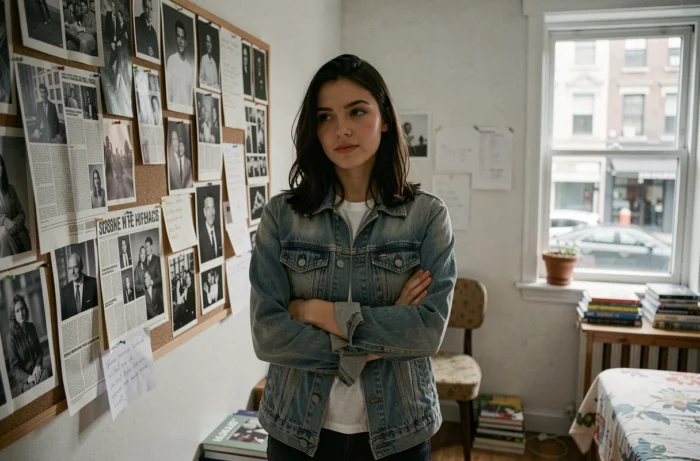
Biography of Ann Ray: what the youth clichés reveal about her method
One detail strikes when examining her images from this period: the human body is treated as a structure, not as a romantic subject. You can sense the engineer’s training in the geometric cutting of the shots, in the way light is used to isolate a line, an angle.
This methodical approach distinguishes Ann Ray from her contemporaries who, in the 1990s, often leaned towards artistic blur or deliberate overexposure. She builds. Each photo seems to respond to an invisible set of specifications, as if the engineer’s reflex had never completely disappeared.
The trace of Paris in the early series
Back from Tokyo, Ann Ray settles in Paris. The city becomes a recurring playground in her series. Parisian interiors, workshops, and the backstage of fashion offer a setting that her photos transform into an intimate space. Paris functions here as a permanent studio, not as a postcard backdrop.
What strikes in these Parisian works is the absence of ironic distance. Ann Ray does not photograph fashion or luxury with the detachment of a reporter. She enters the spaces, settles in, and produces images that have the texture of a personal journal while maintaining a marked formal rigor.
Exhibition “Fragile” in Arles: re-reading Ann Ray’s youth photos
The exhibition “Fragile,” presented at the Space Between gallery in Arles, allows for a revisit of Ann Ray’s entire journey with a perspective that her early shots did not offer. It shows how the fragility of the subject has become the guiding thread of her entire work, from the first images to the most recent series.
This exhibition highlights a point that social media often obscures when sharing her photos: Ann Ray’s work is not limited to a few portraits shared online. It is a body of work built over several decades, with a thematic coherence that dates back to the very first shots taken in Japan.
What “Fragile” changes in the reading of her images
Seeing Ann Ray’s youth photos hung alongside her recent works produces a concrete effect: one identifies the constants. A few elements systematically recur:
- An use of natural light as the main material, even in dark or confined spaces
- A physical proximity to the subject that abolishes the boundary between photographer and model
- Prints that prioritize grain and texture over pure technical sharpness
These constants are not the result of a pre-written artistic manifesto. They emerge from the very first images, almost instinctively, and refine over the years. Ann Ray’s style was already present in her youth photos, in a raw form that time has simply sharpened.
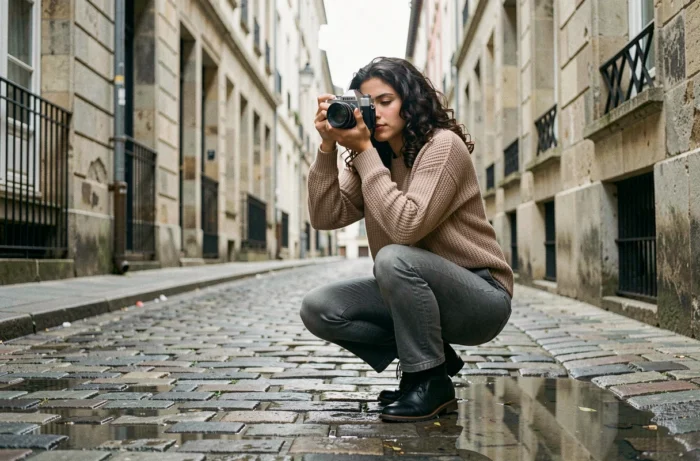
Artistic journey of Ann Ray: from engineering to author photography
We often speak of career change as a break. In the case of Ann Ray, opinions vary on this point, but her images suggest rather an underground continuity. The analytical rigor of the engineer has not been abandoned: it has been redirected towards another material.
Her youth photos show an artist who does not seek to seduce but to understand. Each series functions as a visual investigation, with its hypotheses, variations, and provisional conclusions. Ann Ray’s photography proceeds by methodical accumulation, not by isolated bursts of brilliance.
This journey, from technical training to author work exhibited in Arles, reminds us that an artist’s trajectory is not only read in their final works. The youth photos, with their clumsiness and intuitions, already contain the visual grammar that will become Ann Ray’s signature. The passage through Tokyo, the return to Paris, the “Fragile” exhibition outline a coherent line that only time allows to reconstruct.