The query “Aurélie Casse legs” regularly appears in French search engines. This recurring search volume raises questions: what is it about the television setup or the journalist’s personal trajectory that fuels this focus on a part of her body rather than on her work on air?
Set Framing and Body Exposure of Female Presenters
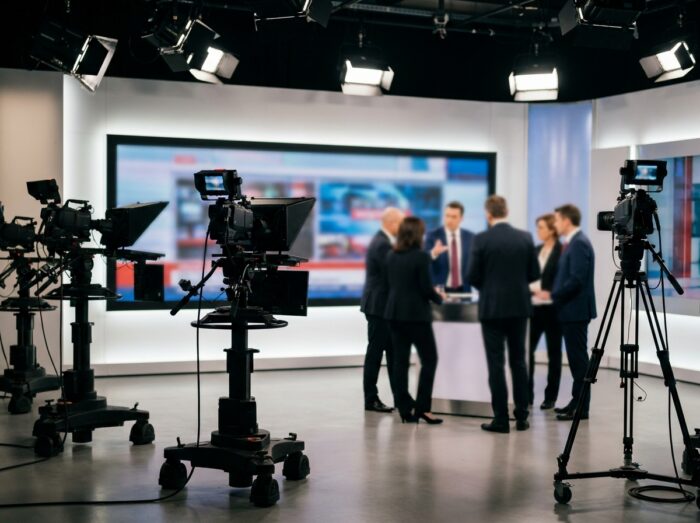
The staging of a talk show like C l’hebdo or C à vous on France 5 relies on an open set, low chairs, and wide shots that capture the entirety of the silhouette. This type of framing, designed to create proximity with the viewer, has a secondary effect: the legs of the female presenters become a permanent element of the visual field.
Male presenters in equivalent roles (hosting debates, live political interviews) almost systematically wear dark trousers behind a closed desk. Their bodies disappear from the frame. In contrast, female presenters sitting in a set chair, filmed in medium or wide shots, have every detail of their clothing and physical appearance exposed for sometimes more than an hour of daily programming.
This asymmetry in framing between men and women on French television mechanically produces an asymmetry of attention. Research on the appearance of male journalists remains marginal. Those concerning Aurélie Casse’s legs on television illustrate a structural bias that the technical setup amplifies without creating it.
Visible Scar on Air: When Aurélie Casse Transforms Curiosity into Assumed Discourse
Aurélie Casse has publicly mentioned a scar on her thigh, which she describes as a “big scar.” This disclosure, notably reported by Closer, shifted the public’s gaze. The scar acknowledged on air has transformed a physical curiosity into a subject of personal testimony.
This shift deserves analysis. Before this statement, searches focused on appearance. Afterward, they gained a biographical dimension: internet users now seek to understand the origin of this mark, the context of the childhood injury, and how the journalist lives with this unchosen visibility.
The Effect of Transparency on Search Volume
When a public figure openly discusses a physical peculiarity, the associated search volume temporarily increases before stabilizing at a level higher than the initial one. Personal discourse fuels curiosity instead of extinguishing it, but it changes its nature: it shifts from voyeuristic searching to informative searching.
Aurélie Casse made this choice in an interview, not on air during her show. The boundary between professional life and personal disclosure remains drawn on her side, even if Google queries do not make this distinction.
Gendered Searches on Journalists: Comparative Data
| Criteria | Female Journalists | Male Journalists |
|---|---|---|
| Searches Related to Appearance | Frequent (legs, outfit, hairstyle, weight) | Rare (almost nonexistent) |
| Dominant Set Framing | Medium or wide shot, open chair | Chest shot, closed desk |
| Social Media Comments on Appearance | Recurring with each show | Occasional and anecdotal |
| Public Discourse on the Body | Often solicited by the media | Rarely addressed |
This table summarizes an asymmetry that Aurélie Casse’s case makes particularly clear. Searches about the bodies of female journalists constitute a structural phenomenon, not an isolated case.
Aurélie Casse’s Professional Journey on France 5 and BFMTV
The attention given to Aurélie Casse’s legs obscures a dense television career. The journalist was one of the faces of BFMTV before joining France 5, where she held several positions in a short time.
- Columnist on C à vous alongside Anne-Élisabeth Lemoine, a position she left after four months for reasons she publicly defended
- Presenter of C l’hebdo on France 5 for two seasons, with a daily slot from 7 PM to 8:20 PM
- Substitute for Anne-Élisabeth Lemoine on the first part of C à vous for about fifteen days in May 2026
These rapid transitions have fueled a strong media personalization. The public follows both Aurélie Casse’s career moves and the content of her shows, creating fertile ground for all forms of curiosity, including physical.
The Stress of Being on Air and Its Physical Effects
Aurélie Casse has also shared that she went through periods of intense stress during her years at BFMTV, to the point of experiencing physical effects. This type of testimony, which touches on what she describes as an issue affecting a significant portion of the population, helps to humanize the figure of the presenter.
The irony is that this humanization, far from diverting attention from the body, reinforces it. Each physical or emotional disclosure becomes a new entry point for online searches.
Aurélie Casse and the Public’s Gaze: What Google Queries Really Measure
Search engines do not measure admiration or disdain. They record a raw volume of curiosity. The recurrence of searches on Aurélie Casse’s legs reflects a collective mechanism, not an opinion.
Three factors converge to explain this attention:
- A set design that exposes women’s bodies more than men’s
- A personal disclosure about a visible scar, which has legitimized the subject in the public space
- Growing notoriety linked to frequent job changes, keeping the journalist in the media spotlight
None of these factors are unique to Aurélie Casse. Other female presenters experience the same type of focus. The difference lies in the conjunction of the three elements in one person, at a time when her media visibility is at its highest.
The search volume will eventually decline if the set design evolves or if the journalist changes format. In the meantime, each appearance on air reignites the cycle. The public’s gaze is a product of television framing as much as individual curiosity.